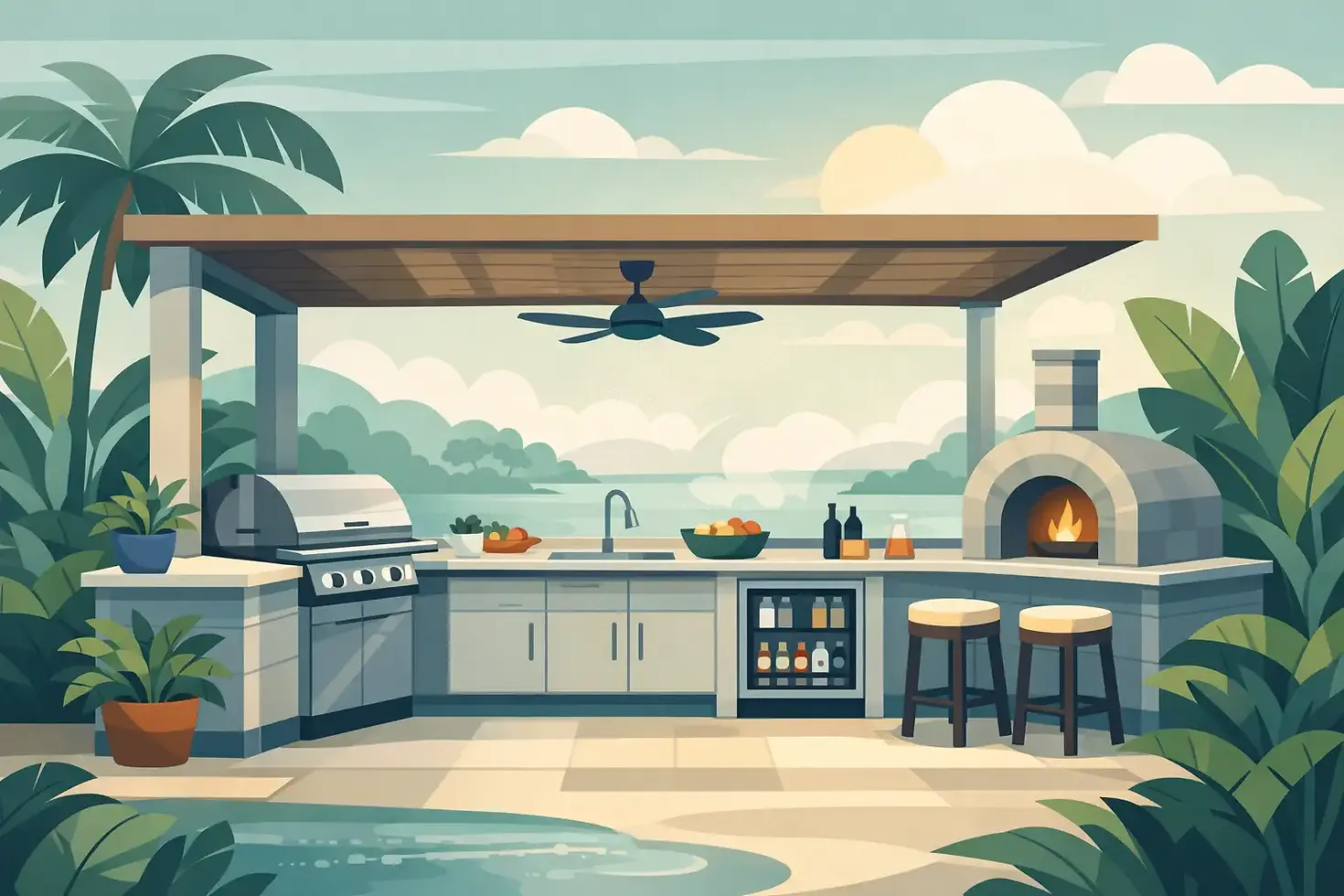
Humid Climate Outdoor Kitchen Done Right

You can spot a bad outdoor kitchen in Florida fast. Doors start sticking, finishes swell, fasteners stain, and what looked sharp on day one starts looking tired after one long wet season. A humid climate outdoor kitchen has to do more than photograph well. It has to stay solid, clean, and functional through heat, moisture, salt air, storms, and year-round use.
That is where build quality stops being a marketing phrase and starts becoming the whole project. If you live in a place where the air stays heavy and the rain comes hard, your outdoor kitchen should be built like an exterior structure, not treated like indoor cabinetry pushed onto a patio. The difference shows up in how it performs after years outside.
What humidity actually does to an outdoor kitchen
Humidity is rarely the only problem. In coastal and warm-weather markets, moisture usually shows up with heat, UV exposure, wind-driven rain, and in some areas, salt in the air. Those forces work together. Materials expand and contract, finishes break down faster, and low-grade hardware starts corroding long before most homeowners expect it.
The first failures are often the small ones. Hinges stop moving smoothly. Panels look uneven. A once-flat surface starts telegraphing what is happening underneath. Then the bigger issues follow - weak framing, finish damage, trapped moisture, and components that become harder to maintain every season.
That is why a humid climate outdoor kitchen needs a real construction strategy. Good looks matter, but they come after the structure, not before it.
The frame matters more than the face
If the frame is weak, the project is weak. This is where many outdoor kitchens get value-engineered into future repair work. They may look polished in photos, but behind the finish there is often a structure that was never meant for constant exposure.
A welded aluminum frame changes that. When the core structure is built from welded 1x2x1/8-inch aluminum tubing, you get strength without the rust issues that destroy lesser systems over time. That matters in humid environments because moisture finds every vulnerable point. If your frame cannot handle it, the rest of the kitchen does not stand a chance.
Welded fabrication also creates a more stable build than pieced-together systems that rely too heavily on connectors and compromise points. A custom kitchen should feel permanent because it is. It should be engineered for outdoor living, not assembled like a temporary feature.
Humid climate outdoor kitchen materials that hold up
The right material package is what separates a luxury installation from a high-maintenance mistake. In humid environments, every exposed component should earn its place.
Stainless steel hardware is one of those non-negotiables. Fasteners, hinges, and attachment points need corrosion resistance because they take constant abuse from moisture in the air and direct exposure during storms and cleaning. The same goes for quality stainless doors and appliances, which give you durability where function matters most.
But an outdoor kitchen does not need to be wrapped in high-maintenance metal to perform. In fact, all-metal cabinet exteriors can become a constant upkeep issue, especially when fingerprints, water spots, and surface grime show up easily. Architectural masonry finishes offer a smarter path. They deliver a cleaner visual finish, reduce the maintenance burden, and give the kitchen a more integrated, built-in look that fits the home instead of looking dropped in from a showroom.
This is one of those areas where experience matters. A kitchen built for Florida should not just survive the climate. It should be easier to live with in that climate.
Design details that make a real difference
A durable outdoor kitchen is not only about the materials on a spec sheet. It is also about how the kitchen is laid out and detailed.
Ventilation matters. Heat and trapped moisture around grills, storage areas, and enclosed cavities can shorten the life of components and create performance problems. Clearances matter too, especially around appliances and masonry finishes that need room to breathe and move properly through temperature changes.
Overhangs, covered placements, and orientation can improve longevity, but they are not a substitute for proper construction. Even under a lanai or covered patio, humidity stays present. If a builder assumes the roof solves the climate issue, the kitchen is already being designed with the wrong mindset.
Drainage is another quiet factor that should never be ignored. Water needs a path away from critical areas. Surfaces should not encourage pooling, and details should avoid creating hidden moisture traps. In a humid climate, trapped water is never a small issue. It just becomes an expensive one later.
Why custom beats one-size-fits-all
No two backyards cook the same way, and no two exposures are identical. That is why a custom approach makes more sense than forcing your space into a standard layout.
A homeowner who grills three nights a week needs a different setup than someone designing for large weekend entertaining. A waterfront property has different demands than a screened pool deck inland. Wind, sun, available cover, traffic flow, and appliance choices all affect what the finished kitchen should be.
A true custom build allows the structure, finishes, storage, and cooking zones to be designed around how you actually live. More important, it allows the construction methods to respond to site conditions instead of pretending every backyard has the same demands. That flexibility is not a luxury add-on. In humid climates, it is part of building the job correctly.
Looks still matter, but they need to be earned
Homeowners investing in a premium outdoor kitchen want it to feel like part of the home, not just part of the patio. That expectation is fair. A high-end build should elevate the whole outdoor space.
But the visual finish only means something when the structure underneath is worthy of it. A polished facade over weak materials is not premium. It is just delayed disappointment. The best kitchens balance both sides - a refined finish on top of a fabrication-driven build that is ready for real weather.
That is especially true in Southwest Florida, where outdoor living is not seasonal. These kitchens get used year-round. They host family dinners, game days, holidays, and casual weeknights after work. The environment is demanding, but so is the lifestyle. The kitchen needs to stand up to both.
The trade-offs homeowners should understand
There is no such thing as a zero-maintenance outdoor kitchen. Anything outside requires care. The real question is whether the kitchen was built to minimize problems or invite them.
Some materials may offer a lower entry price but demand more upkeep or shorter replacement cycles. Some designs look clean on paper but create tighter spaces, poor ventilation, or service headaches once appliances are installed. Some finishes are attractive initially but show wear quickly in wet, high-UV conditions.
A better build usually costs more upfront because the structure, fabrication, and finish standards are higher. That is the trade-off. You spend more to avoid rebuilding, refinishing, or fighting constant maintenance later. For many homeowners, especially those planning to stay in their home and use the space often, that is the smarter investment.
Choosing the right builder for a humid climate outdoor kitchen
A good question to ask any builder is simple: what is this kitchen made of behind the finish? If the answer is vague, that should tell you something.
You want a builder who talks clearly about framing, hardware, finish systems, and climate performance. You want someone who understands that Florida is not a generic market and that outdoor construction here has to be approached with intention. Materials should be selected for exposure. Fabrication should be part of the process, not an afterthought. And the finished product should feel built, not pieced together.
Primal Outdoor Kitchens approaches these projects with that standard in mind - built for the elements, designed for life. That means structural integrity first, premium finish work second, and no shortcuts hidden behind surface appeal.
A backyard kitchen should make your home more enjoyable, not give you another thing to worry about every rainy season. If you are planning a permanent outdoor upgrade in a humid market, choose a build that respects the climate from the start. The right kitchen does not fight the environment. It is made for it.


Comments